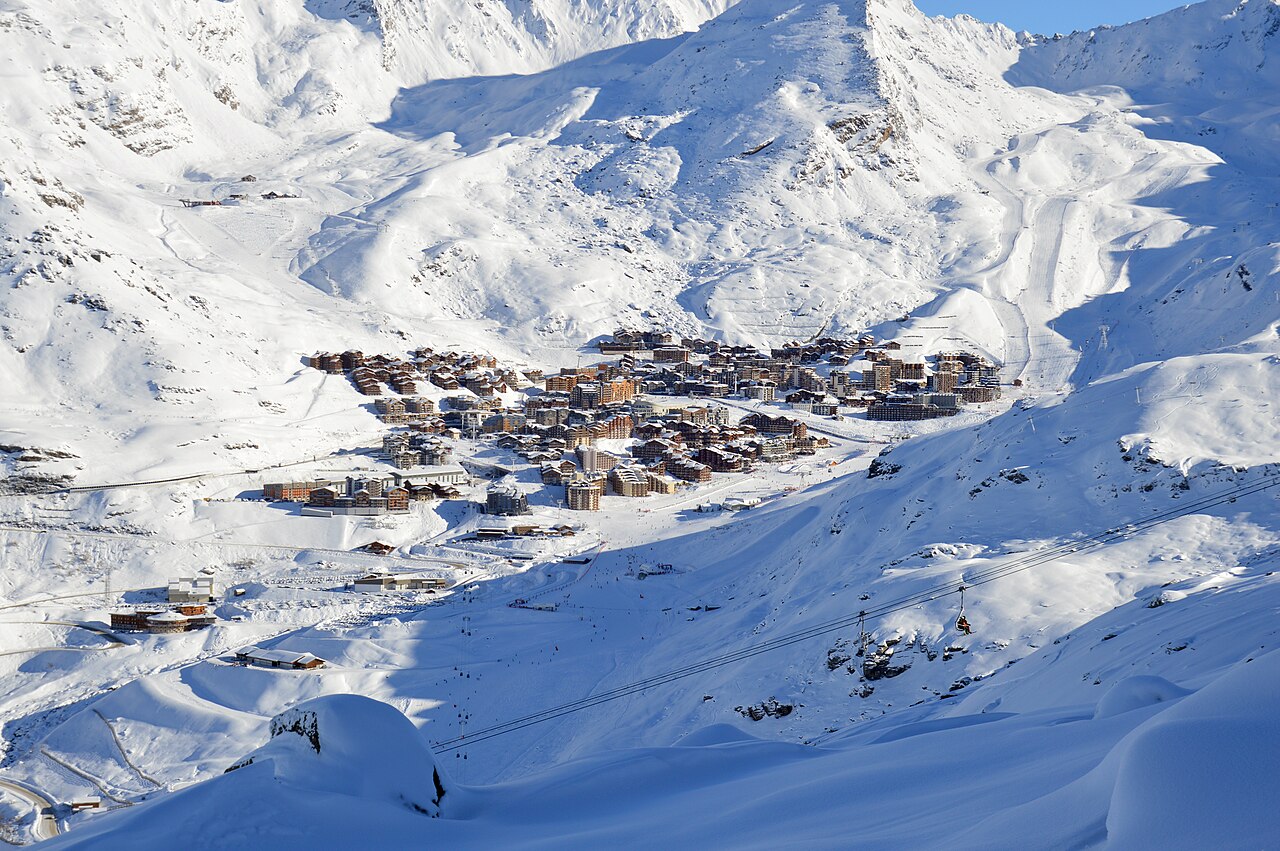
Val Thorens is the highest ski resort village in Europe at 2,300m, anchoring the southern end of Les 3 Vallées - the world's largest linked ski area with 600km of pistes. Its own Val Thorens-Orelle sector offers around 150km of almost entirely above-treeline skiing up to 3,230m at Pointe du Bouchet, making it one of the most snow-sure destinations in the Alps with a season that regularly stretches from late November into early May.
Terrain Breakdown
Mountain Stats
Highlights
Pros
- ✓Most snow-sure major resort in the Alps - high altitude keeps conditions good even in lean seasons
- ✓One Val Thorens/Orelle pass (~€74/day) covers a huge 150km area, with 3 Vallées upgrades unlocking 600km
- ✓Almost everything is above the treeline, so wide-open bowls and long verticals abound
- ✓True ski-in/ski-out convenience from nearly every hotel and apartment in the village
- ✓Long season from late November to early May, bookended by cheaper deals
Cons
- ✗Entirely above the treeline, so whiteouts and wind shut down visibility with nowhere to hide
- ✗Purpose-built 1970s village lacks the charm of traditional Alpine towns
- ✗Very crowded in peak weeks - the 3 Vallées pulls enormous European holiday traffic
- ✗Long transfer (2.5-3 hours) from Geneva or Lyon airports up a winding mountain road
Skier Insightssummarized from Reddit and ski forums
Val Thorens is Europe's highest resort village and the continent's surest bet for snow, and the community treats it as exactly that: the place you book in November, December, or a bad snow year when everywhere lower is brown. Repeat winner of World's Best Ski Resort awards, it sits at 2,300m at the top of the Belleville valley, all of its skiing above the trees, with a purpose-built village whose 1970s concrete gets forgiven the moment you click in outside your door. The vibe is young, international, and loud - this is the 3 Vallées' party corner, not its Michelin-star corner.
The skiing is high, wide, and mostly open bowls: 150km locally between Val Thorens and the quiet Orelle sector, 600km if you upgrade to the full 3 Vallées pass and tour toward Méribel and Courchevel. Intermediates get the best of it - endless red-and-blue mileage at altitude - while experts poke into the Combe de Caron and off-piste that stays cold and chalky. Two 2025-26 upgrades matter: the iconic Cime Caron cable car reopened with new cabins, and the new Face Nord gondola replaced two old chairs while easing the Orelle connection. The recurring complaint is weather-binary skiing: bluebird days are glorious, but storms and whiteouts close the exposed lifts with nothing tree-lined to fall back on, and February school holidays pack the pistes to genuinely stressful levels.
It's best for intermediates who want mileage, groups mixing serious skiing with serious après, early- and late-season bookers, and anyone burned by low-altitude slush elsewhere. Value is strong for the Alps - €74ish day passes, walkable ski-in/ski-out apartments - though the Geneva transfer is long and Saturday changeovers are chaos. Note for pass holders: Les 3 Vallées is an Epic Pass partner destination, which sweetens the math for Vail-pass loyalists doing a Europe trip. Versus Verbier: less charm and less legendary off-piste, but better snow certainty, better piste mileage, and half the bar bill. January for empty cold pistes, March-April for sunny bowls when lower resorts are done.
What skiers like
- +The most reliable snow of any major Alpine resort - at 2,300m with skiing to 3,230m, it opens in November and runs to early May even in the lean seasons that leave lower French resorts on grass
- +The Cime Caron cable car returned for 2025-26 with brand-new cabins, restoring direct access to the 3,200m summit and its 360-degree panorama over a thousand peaks
- +The new Face Nord 10-seater gondola (also new for 2025-26) replaced two old chairs and smooths the link toward the quiet Orelle sector
- +True doorstep skiing: nearly every hotel and apartment in the village is genuinely ski-in/ski-out, which regulars say transforms family trip logistics
- +One lift pass decision unlocks a spectrum - the local Val Thorens-Orelle area is ~150km of high-alpine skiing on its own, and the full 3 Vallées upgrade opens 600km toward Méribel and Courchevel
- +Après is a genuine institution - the 360 Bar and La Folie Douce's mid-afternoon table-dancing spill into a village with more nightlife than the rest of the Belleville valley combined
- +Orelle-side skiing stays remarkably quiet even in peak weeks - a known escape valve the February crowds mostly ignore
- +Value by Alps standards is real: day passes around €74, and self-catered apartment deals undercut Courchevel and Verbier dramatically
Common complaints
- −Everything is above the treeline, so when cloud or storm rolls in there is nowhere to hide - whiteout days flatten the terrain into milk and can shut the whole upper mountain
- −Wind closures are routine; the same exposure that keeps it snow-sure closes the high lifts and the 3 Vallées links exactly when storms deliver the goods
- −The 1970s purpose-built village is function over charm - concrete-and-apartment aesthetics that no amount of renovation fully disguises
- −February half-term and French school weeks bring enormous crowds - piste-crossing chaos on the runs back to the village and long waits at the key connectors
- −The party reputation cuts both ways: student groups and stag trips mean noisy apartment blocks and a 2am soundtrack in the center
- −The transfer is a grind - 2.5-3 hours up switchbacks from Geneva or Lyon, and Saturday changeover traffic on the Moutiers road is legendary in the worst way
- −Piste grooming takes a beating from the volume; by afternoon the main homeward runs are scraped, mogully, and full of exhausted skiers
- −High-altitude cold is no joke in January - minus-20 windchill days with no trees for shelter test any family's resolve
Common Questions
Is Val Thorens covered by the Epic Pass?
Val Thorens local pass or full 3 Vallées pass - which should I buy?
When is the best time to go?
Is Val Thorens good for beginners?
What's new at Val Thorens for 2025-26?
How rowdy is the party scene - can families still enjoy it?
Photo: DimiTalen / Wikimedia Commons (CC0)
← Back to All Resorts